
How to Set a Smart Cat Feeder Schedule for Different Cat Needs | CC001 Dual-Bowl Guide
Date: 2025-12-30 Categories: Guides Hits: 1505
How to Set a Smart Cat Feeder Schedule for Different Cat Needs
Introduction
Free feeding may seem convenient, but for many cats it quietly leads to overeating, irregular digestion, and long-term weight issues. Cats are natural grazers with small stomachs, yet in modern indoor environments, unrestricted access to food often conflicts with their biological feeding patterns. This is where scientifically scheduled feeding becomes essential.
Automatic feeders are not simply about dispensing food at fixed times. When used correctly, they help replicate a cat’s natural eating rhythm, regulate calorie intake, and create a stable daily routine that supports both physical health and behavioral balance. However, many cat owners make the mistake of focusing only on how many times food is dispensed—without understanding how much is given per portion and why those portions are timed a certain way.
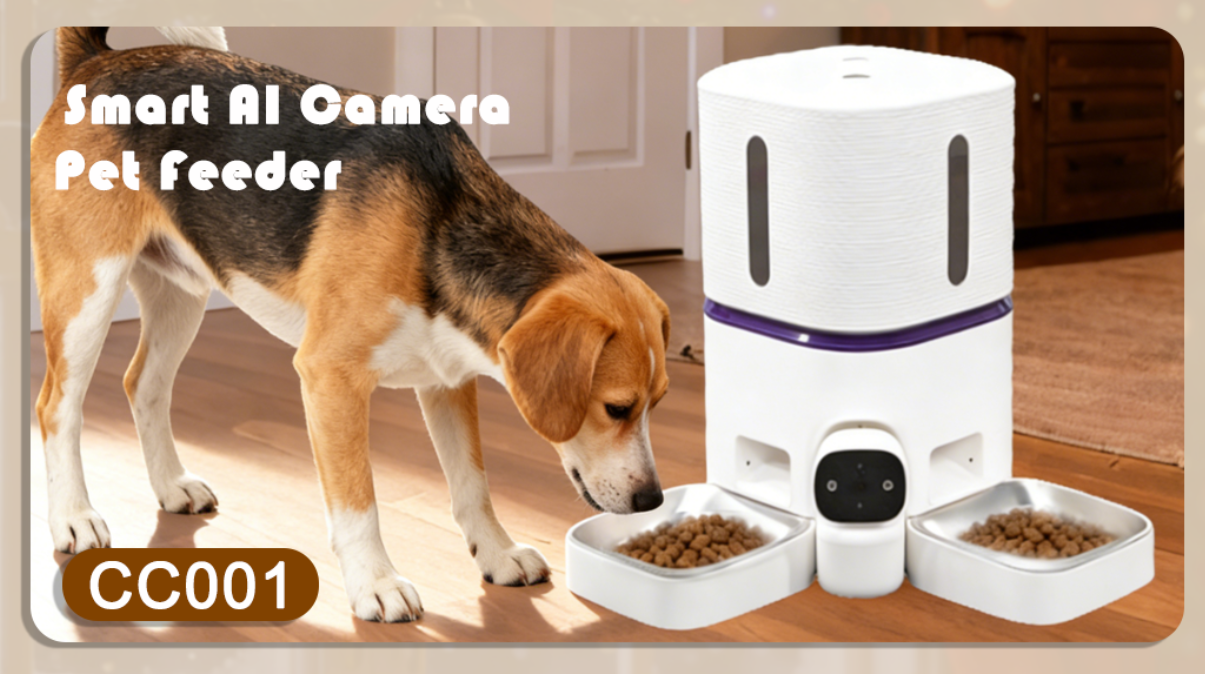
In this article, we use the CC001 Dual-Bowl AI Camera Smart Feeder as a practical example to explain how feeding schedules should be designed around a cat’s real needs. With its dual-bowl structure and the ability to dispense approximately 10 grams per bowl per serving, CC001 allows for precise portion control and consistent feeding—two factors that are often missing in traditional feeding methods.
Whether you are caring for a growing kitten, a strictly indoor adult cat, a neutered cat prone to weight gain, or multiple cats sharing the same space, the right feeding schedule is never one-size-fits-all. By understanding how to combine portion size, feeding frequency, and observation data, you can turn an automatic feeder from a simple convenience tool into a reliable part of your cat’s long-term health management system.
The sections below break down how to build feeding schedules step by step—starting from understanding your cat’s needs, to applying them practically using CC001’s dual-bowl, small-portion dispensing logic.
Section I – What Really Determines a Cat’s Feeding Schedule
Setting an effective feeding schedule is not about copying a generic chart or following the instructions printed on a food bag. A scientifically sound schedule starts with understanding what actually drives a cat’s nutritional and behavioral needs. Before touching the timer settings on an automatic feeder, the following factors should be evaluated.
1.1 Age and Life Stage
A cat’s age directly affects metabolism, stomach capacity, and nutrient demand.
Kittens require more frequent meals because of rapid growth and higher energy expenditure. Their digestive systems handle small portions better, making multiple daily feedings essential.
Adult cats have more stable metabolic rates and benefit from consistent, predictable feeding times rather than frequent changes.
Senior cats often experience slower digestion and reduced appetite per meal, which makes smaller portions spaced evenly throughout the day easier to tolerate.
A feeding schedule that works well for a two-year-old indoor cat may be entirely inappropriate for a ten-year-old senior.
1.2 Body Weight and Physical Condition
Body weight alone is not enough—body condition matters more.
Cats that are underweight may need additional feeding sessions rather than larger single portions.
Cats at a healthy weight benefit from balanced portion control to maintain stability.
Overweight or neutered cats typically require tighter portion control and longer intervals between meals to prevent unnecessary calorie accumulation.
With a feeder like CC001, which dispenses approximately 10 grams per bowl per serving, weight management is achieved by adjusting meal frequency, not increasing portion size.
1.3 Lifestyle: Indoor vs. Active Cats
Activity level significantly influences calorie requirements.
Strictly indoor cats burn fewer calories and are more prone to boredom eating. Regular, evenly spaced meals help prevent excessive snacking behavior.
Cats with access to larger spaces or higher activity levels may require slightly higher total daily intake, but still benefit from small, controlled portions.
Matching feeding times to active and rest periods often improves digestion and reduces food-related anxiety.
1.4 Health and Special Dietary Needs
Medical and digestive considerations should always override convenience.
Cats with sensitive stomachs or a tendency to vomit often tolerate small, frequent meals better than large portions.
Post-surgery or recovery periods may require temporary schedule adjustments.
Any veterinarian-recommended dietary plan should be translated into portion-based scheduling rather than ad-hoc feeding.
Automatic feeders are most effective when they reinforce consistency—an essential factor in managing health-related feeding needs.
1.5 Household Structure and Feeding Environment
The environment in which a cat eats matters as much as what it eats.
In multi-cat households, competition and stress can lead to rushed eating or missed meals.
Cats that feel rushed may overeat when food becomes available.
A predictable schedule reduces anxiety and helps establish a calm feeding routine.
Dual-bowl designs, such as the CC001, support fair and simultaneous feeding, which becomes especially important when more than one cat shares the same feeding space.
Section II – Understanding Portion Control with CC001
Before deciding when to feed, it is critical to understand how much food is dispensed each time. Portion control is the foundation of any scientific feeding schedule, and it is also where many automatic feeder setups fail. CC001’s design makes portion logic clear and measurable, which allows feeding plans to be built with intention rather than guesswork.
2.1 How CC001 Dispenses Food
The CC001 is a dual-bowl smart feeder designed to dispense food simultaneously into two bowls, with each serving releasing approximately 10 grams per bowl. This consistency is important for two reasons:
Each feeding event delivers a predictable amount of food
Total daily intake can be calculated simply by adjusting feeding frequency
Rather than relying on vague cup measurements or manual estimation, CC001 allows owners to work with small, repeatable portions.
2.2 Why Small Portions Matter More Than Large Meals
Cats are physiologically adapted to eat multiple small meals throughout the day, not one or two large servings.
Large meals often lead to:
Rapid eating and vomiting
Blood sugar fluctuations
Reduced satiety control
By contrast, smaller portions delivered at regular intervals:
Reduce digestive stress
Improve nutrient absorption
Help maintain steady energy levels
With CC001’s ~10 g per bowl logic, feeding becomes about distribution, not volume.
2.3 Adjusting Total Daily Intake Through Frequency
A common mistake is attempting to increase or decrease food by changing portion size. With CC001, the more effective approach is to adjust how many times food is dispensed per day.
For example:
3 feedings per day = ~30 g per bowl
5 feedings per day = ~50 g per bowl
This approach allows gradual adjustments without disrupting the cat’s routine or digestive rhythm.
2.4 Dual-Bowl Portion Logic in Practice
Even in single-cat households, the dual-bowl structure encourages:
Slower eating
More natural pacing
Reduced food guarding behavior
In multi-cat households, it ensures:
Equal access at the same time
No dominance-based food control
Clear visibility of whether food is being consumed
Because both bowls receive the same amount at the same moment, portion fairness is built into the system.
2.5 Portion Control Is a Long-Term Strategy
Portion control is not a one-time setup. Cats’ needs change with age, weight, and activity level. The advantage of CC001 lies in its precision and repeatability, which makes it easier to:
Track changes in appetite
Make incremental adjustments
Maintain consistency over time
Once portion logic is understood, feeding schedules stop being guesswork and become a structured, data-driven routine. In the next section, we will apply this portion framework to real-world feeding schedules for different types of cats.
2.6 Recommended Daily Dry Food Intake by Age (Reference Range)
While individual needs vary based on body weight, activity level, and food formulation, age provides a reliable baseline for estimating daily dry food intake. Understanding these ranges helps translate nutrition theory into practical feeder settings.
2.6.1 Kittens (Under 12 Months)
Kittens grow rapidly and have higher energy demands, but smaller stomach capacity.
Typical daily intake:
50–70 g per day (depending on growth stage and body weight)
Feeding strategy:
More frequent meals
Smaller portions per feeding
With CC001:
5–7 feedings per day
~10 g per bowl per feeding
This approach supports steady growth without overloading the digestive system.
2.6.2 Adult Cats (1–7 Years)
Healthy adult cats have relatively stable caloric needs.
Typical daily intake:
40–60 g per day for an average 4–5 kg indoor cat
Feeding strategy:
Consistent timing
Evenly distributed meals
With CC001:
3–5 feedings per day
Portion control achieved through frequency, not volume
Indoor cats on the lower end of activity often perform better closer to the lower range.
2.6.3 Neutered or Overweight Adult Cats
Metabolism typically slows after neutering, increasing the risk of weight gain.
Typical daily intake:
35–45 g per day
Feeding strategy:
Strict portion consistency
Avoid large single meals
With CC001:
3–4 feedings per day
Avoid compensatory extra feedings
Smaller, predictable portions help regulate appetite and reduce food-seeking behavior.
2.6.4 Senior Cats (7+ Years)
Senior cats may eat less per meal but benefit from easier digestion.
Typical daily intake:
35–55 g per day, depending on muscle condition and health
Feeding strategy:
Smaller portions
Even spacing, including optional late-night feeding
With CC001:
4–5 feedings per day
Maintain total intake while reducing per-meal load
This reduces digestive strain and helps maintain lean body mass.
Important Notes on Food Weight
All gram references are based on dry food
Calorie density varies by brand—always cross-check with the food’s kcal/100 g label
These values are guidelines, not fixed rules
The advantage of CC001 lies in its ability to convert these ranges into repeatable 10 g portions, allowing owners to fine-tune intake gradually without disrupting feeding behavior.
Section III – Feeding Schedules by Cat Type (Practical Scenarios)
Once daily intake ranges and portion logic are clear, the next step is translating them into practical, repeatable feeding schedules. Below are real-world scheduling scenarios based on common cat profiles, using CC001’s ~10 g per bowl per feeding as the fixed portion unit. These examples are designed to be adjusted, not followed blindly.
3.1 Kittens (Growing Cats)
Kittens require frequent energy intake to support growth, but their digestive systems cannot handle large meals.
Recommended daily intake:
50–70 g of dry food
Feeding strategy:
High frequency
Small, evenly spaced meals
Avoid long fasting periods
CC001 sample schedule:
6 feedings per day
~10 g per bowl per feeding
Total: ~60 g per day
Example timing:
07:00 / 10:00 / 13:00 / 16:00 / 19:00 / 22:00
This schedule maintains stable blood sugar levels and reduces the risk of overeating or vomiting.
3.2 Adult Indoor Cats (Healthy Weight)
Adult indoor cats benefit most from consistency rather than frequent adjustments.
Recommended daily intake:
40–60 g of dry food
Feeding strategy:
Moderate frequency
Fixed time slots
Predictable routine
CC001 sample schedule:
4 feedings per day
~10 g per bowl per feeding
Total: ~40 g per day
Example timing:
08:00 / 13:00 / 18:00 / 23:00
This spacing aligns well with natural activity and rest cycles in indoor environments.
3.3 Neutered or Overweight Cats
These cats are more prone to overeating and should not receive large single meals.
Recommended daily intake:
35–45 g of dry food
Feeding strategy:
Fewer feedings than kittens
Strict portion control
Avoid late-night overfeeding
CC001 sample schedule:
3–4 feedings per day
~10 g per bowl per feeding
Total: ~30–40 g per day
Example timing:
08:00 / 16:00 / 22:00
Slower intake and longer intervals help control calorie consumption without causing food anxiety.
3.4 Senior Cats (7+ Years)
Senior cats often eat less per meal but still need sufficient daily nutrition.
Recommended daily intake:
35–55 g of dry food
Feeding strategy:
Smaller meals
Even spacing
Optional late-night feeding
CC001 sample schedule:
4–5 feedings per day
~10 g per bowl per feeding
Total: ~40–50 g per day
Example timing:
07:00 / 12:00 / 17:00 / 21:00 / 01:00 (optional)
This reduces digestive load while preventing long fasting periods overnight.
These scenarios are starting points, not fixed prescriptions. Adjustments should be based on:
Body condition changes
Leftover food in the bowl
Eating speed and behavior
Activity level changes
CC001’s precise, repeatable dispensing makes it easier to fine-tune schedules gradually without disrupting routine. In the next section, we will focus on multi-cat households and explain why dual-bowl, synchronized feeding becomes critical in shared environments.
Section IV – Multi-Cat Households: Why Dual Bowls Matter
Feeding multiple cats in the same household presents unique challenges that single-cat schedules often fail to address. Competition, stress, and behavioral differences can lead to uneven eating, obesity in some cats, and malnutrition in others. This is where the dual-bowl design of CC001 provides a clear advantage.
4.1 Common Multi-Cat Feeding Issues
Food guarding and aggression: Dominant cats may eat more than their share, leaving timid cats underfed.
Rushed eating: Cats feeling competition often eat too quickly, leading to vomiting or digestive upset.
Skipped meals: Some cats may avoid the feeding area entirely due to stress or fear.
Traditional single-bowl feeders often exacerbate these problems by forcing cats to take turns or compete for limited portions.
4.2 How Dual Bowls Solve These Problems
CC001 dispenses equal portions into two bowls simultaneously, which:
Ensures fair access for each cat at the same time
Reduces dominance-related stress
Encourages slower, calmer eating by separating food slightly between bowls
Even in households with only two cats, this approach prevents food-related conflicts and helps maintain stable weight across both animals.
4.3 Scheduling Strategies for Multi-Cat Households
Synchronize feeding times: Both cats receive food at exactly the same time.
Adjust total daily intake per cat: Use the portion-per-bowl logic to calculate individual daily grams, then set feeding frequency accordingly.
Observe behavior: Monitor if one cat consistently leaves food uneaten; this may indicate preference or health issues requiring adjustment.
Example CC001 schedule for two adult indoor cats (40–50 g/day each):
4 feedings per day
~10 g per bowl per feeding
Total per cat: ~40 g/day
Timing: 08:00 / 12:00 / 18:00 / 22:00
4.4 Benefits Beyond Nutrition
Behavioral stability: Cats learn to anticipate meal times, reducing anxiety-driven begging or food stealing.
Digestive health: Smaller, consistent portions reduce overeating and vomiting.
Ease of monitoring: Owners can quickly see if a cat is eating less or more than usual, facilitating early intervention.
By using a dual-bowl feeder like CC001, multi-cat households can achieve both fair feeding and simplified portion management, which is essential for long-term health and harmony among cats.
Section V – Using AI Camera & Feeding Data to Optimize Schedules
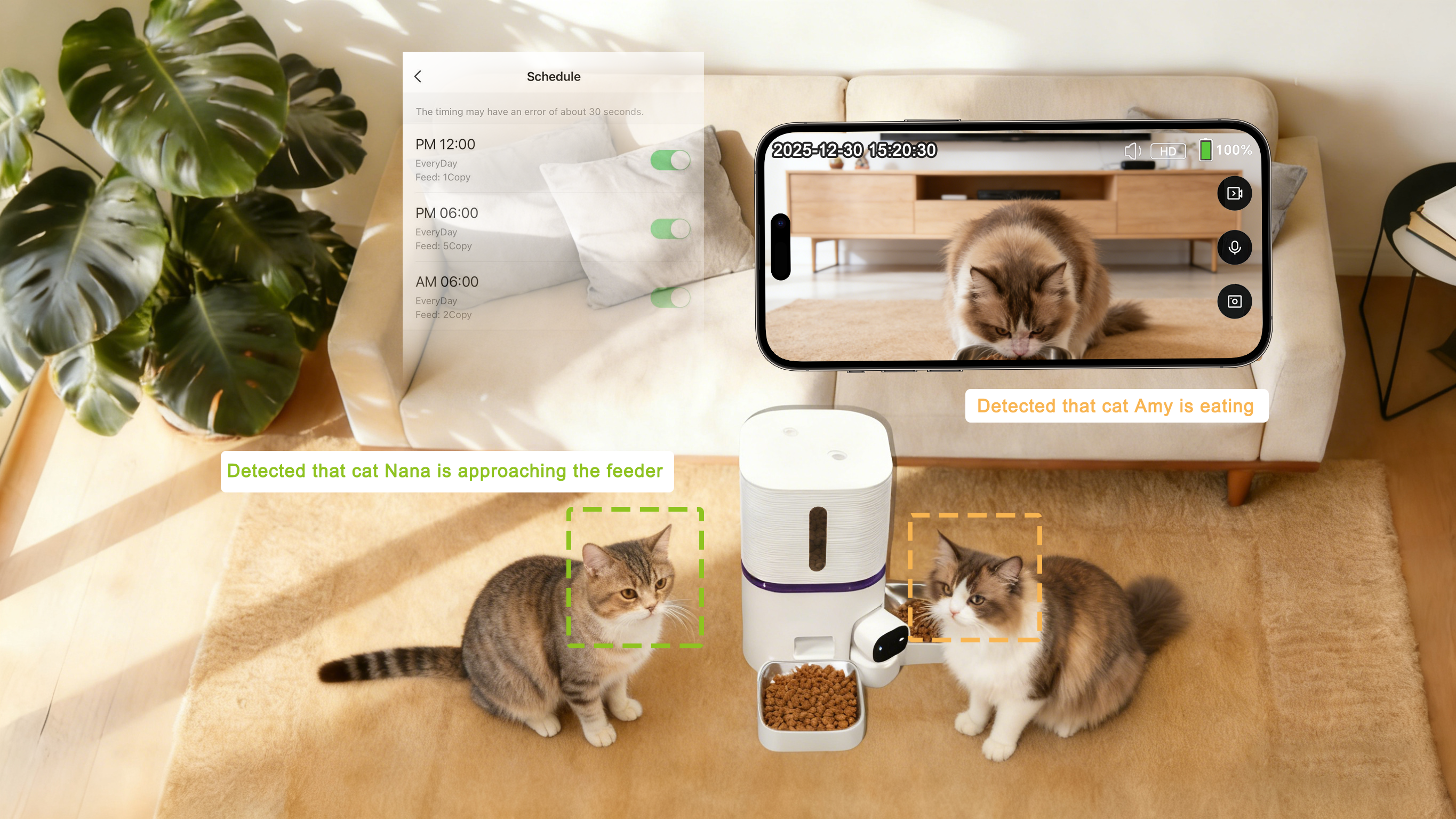
One of the key advantages of the CC001 Dual-Bowl AI Camera Smart Feeder is its ability to provide real-time observation and data-driven insights, transforming feeding from a static schedule into a dynamic, adjustable process. By leveraging the AI camera and feeding records, owners can fine-tune feeding schedules for optimal health and behavior outcomes.
5.1 Observing Eating Behavior
The AI camera allows you to monitor:
Eating speed: Rapid consumption may indicate stress, competition, or health issues.
Skipped meals: Identifying when a cat refuses food can help detect illness early.
Bowl preference or dominance: In multi-cat households, the camera helps track which cat eats from which bowl and how much.
Observation data is more reliable than subjective assumptions, enabling informed adjustments to both timing and portion size.
5.2 Adjusting Schedules Based on Data
Feeding schedules are not one-size-fits-all. With the data collected by CC001:
Increase or decrease frequency: If a cat consistently leaves food uneaten, consider shorter, more frequent meals.
Shift feeding times: Align meals with natural activity periods, such as morning play sessions or evening rest.
Balance intake in multi-cat households: Ensure each cat receives its intended portion without interference.
The AI camera allows small, incremental changes, maintaining consistency while optimizing nutrition.
5.3 Monitoring Health Indicators
Some behavioral patterns captured by the feeder’s camera may indicate underlying health issues:
Eating too quickly or too slowly
Sudden decrease in appetite
Skipping meals over multiple days
Early detection allows timely veterinary consultation. The dual-bowl setup ensures that each cat’s intake is individually trackable, even in a multi-cat environment.
5.4 Combining Data with Portion Control
CC001’s 10 g per bowl per serving system integrates seamlessly with AI monitoring:
Compare actual consumption vs. scheduled portions
Adjust future feedings based on appetite or leftovers
Maintain total daily intake within recommended ranges for age, weight, and activity level
By combining precise portioning with observational data, feeding becomes a dynamic, responsive routine rather than a fixed schedule.
5.5 Best Practices for Using AI Data
Check logs regularly: Daily review helps spot trends before they become problems.
Avoid overreacting to single incidents: Minor variations are normal; focus on patterns.
Integrate veterinary guidance: If changes in feeding behavior persist, consult a vet for tailored advice.
Using AI-driven data effectively allows you to optimize feeding schedules continuously, supporting both physical health and behavioral well-being for your cat.
Section VI – Common Feeding Schedule Mistakes to Avoid
Even with a high-tech feeder like the CC001, owners can unintentionally undermine the benefits of automatic feeding by making simple mistakes. Recognizing these pitfalls helps ensure your cat receives consistent, healthy, and stress-free meals.
6.1 Giving Too Much Food in a Single Serving
Overloading bowls contradicts the principle of small, frequent meals.
Large portions often lead to overeating, vomiting, or digestive discomfort.
With CC001, stick to the ~10 g per bowl per serving and adjust frequency rather than volume.
6.2 Ignoring Cat-Specific Needs
Applying a generic schedule for all cats, regardless of age, weight, or health status, can cause underfeeding or overfeeding.
Each cat’s feeding schedule should consider growth stage, metabolism, and activity level.
Always refer to body condition and observed behavior when adjusting schedules.
6.3 Inconsistent Feeding Times
Cats thrive on predictable routines.
Feeding at irregular times can cause anxiety, begging behavior, or stress-related overeating.
CC001’s timer ensures consistency—use it to reinforce a stable daily routine.
6.4 Overlooking Multi-Cat Dynamics
Treating a multi-cat household as if it has only one cat leads to competition and unequal intake.
Even minor dominance behaviors can result in skipped meals or overconsumption.
Dual-bowl synchronized feeding and careful observation prevent these problems.
6.5 Neglecting Observation and Adjustment
Many owners set the feeder and forget it, assuming that portion size and timing alone are sufficient.
Changes in appetite, activity, or health require schedule recalibration.
Use CC001’s AI camera and feeding logs to track eating patterns and make informed adjustments.
6.6 Forgetting to Account for Treats and Human Feeding
Treats and supplementary food outside the feeder can disrupt total daily intake.
Always include additional snacks in calorie calculations, and avoid compensating by reducing feeder portions excessively.
By avoiding these mistakes, your automatic feeder becomes a reliable tool for maintaining consistent, healthy feeding habits. Combining proper portioning, regular observation, and adaptive scheduling ensures that the feeder supports long-term wellness and behavioral stability in your cats.
Section VII – Sample CC001 Feeding Schedules (Reference Table)
To make practical implementation easier, here is a reference table summarizing suggested feeding schedules for different types of cats using the CC001 Dual-Bowl AI Camera Smart Feeder. Each feeding assumes ~10 g per bowl per serving, and the total daily intake falls within recommended ranges based on age, weight, and activity level.
Note: These are general guidelines. Adjust portions and timing based on your cat’s appetite, body condition, and health status.
| Cat Type | Daily Intake (Dry Food) | Feedings per Day | Portion per Feeding | Suggested Times | Notes |
|---|---|---|---|---|---|
| Kitten (<12 months) | 50–70 g | 6 | 10 g per bowl | 07:00 / 10:00 / 13:00 / 16:00 / 19:00 / 22:00 | Small, frequent meals for growth; avoid long fasting |
| Adult Indoor Cat (Healthy Weight) | 40–60 g | 4 | 10 g per bowl | 08:00 / 13:00 / 18:00 / 23:00 | Consistent timing; moderate frequency |
| Neutered/Overweight Adult Cat | 35–45 g | 3–4 | 10 g per bowl | 08:00 / 16:00 / 22:00 | Strict portion control; prevent overeating |
| Senior Cat (7+ years) | 35–55 g | 4–5 | 10 g per bowl | 07:00 / 12:00 / 17:00 / 21:00 / 01:00 (optional) | Smaller meals; optional late-night feeding to reduce fasting intervals |
7.1 How to Use This Table
Calculate Total Daily Intake: Choose the column that matches your cat’s age, weight, and activity.
Set Portion Frequency: Use CC001’s 10 g per bowl setting to match the number of feedings.
Observe and Adjust: Monitor leftover food and eating behavior using the AI camera. Make small adjustments in feeding frequency or timing as needed.
Multi-Cat Adjustments: For multiple cats, ensure each cat receives its portion simultaneously using the dual-bowl function.
This reference table simplifies the translation from recommended daily intake to actionable feeder settings, ensuring your cat receives nutrition in a controlled, consistent, and stress-free manner.