
Why Multi-Cat Households (4+ Cats) Are the Ideal Users of Automatic Litter Boxes
I. Introduction
Over the past decade, multi-cat households have become increasingly common, especially in North America and parts of Europe. According to the American Pet Products Association (APPA), tens of millions of U.S. households own more than one cat, and a meaningful portion of them care for three, four, or even more cats under one roof. Similar trends are reflected in reports by the American Veterinary Medical Association (AVMA), indicating that multi-cat ownership is no longer niche—it is mainstream.
However, the operational reality of managing four or more cats is fundamentally different from managing one or two. Litter box maintenance scales rapidly with each additional cat. Odor control becomes more complex. Cleaning frequency increases. Behavioral stress between cats can surface if hygiene standards drop even slightly. In households with 4+ cats, the litter area becomes a high-traffic, high-impact zone that directly affects feline health and home sanitation.
This is where the discussion shifts. For single-cat homes, an automatic litter box may be viewed as a convenience product. But for households with four or more cats, it becomes something closer to infrastructure—a system designed to stabilize hygiene, reduce labor intensity, and maintain environmental quality at scale.
In this article, we will examine why multi-cat households (4+ cats) represent the most suitable and rational user group for automatic litter boxes, analyzing the issue from operational, hygienic, and economic perspectives.
II. The Unique Challenges of 4+ Cat Households
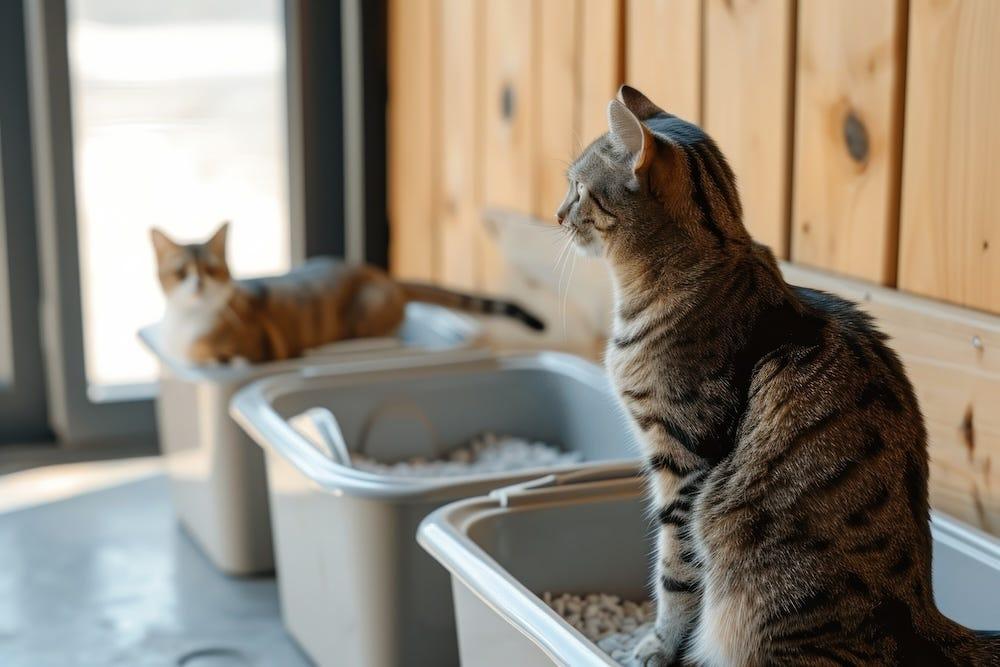
Managing four or more cats transforms litter box maintenance from a routine task into a continuous operational responsibility. The complexity increases not linearly—but exponentially—due to shared space, higher usage frequency, and compounding hygiene variables.
1. Exponential Waste Output
A healthy adult cat typically urinates 2–4 times per day and defecates 1–2 times daily. In a four-cat household, that can translate to:
12–24 urination events per day
4–8 defecation events per day
16–32 total litter interactions daily
In practical terms, this means a traditional litter box can become soiled within hours. Clumps accumulate quickly, moisture spreads, and clean litter surface area diminishes rapidly.
Without frequent scooping (often 3–6 times per day in multi-cat homes), the litter bed becomes saturated, leading to:
Accelerated ammonia buildup
Stronger persistent odor
Increased litter consumption due to premature full-box dumping
The waste management load in a 4+ cat environment is simply too high for once-daily maintenance.
2. Hygiene & Health Risks
The American Association of Feline Practitioners (AAFP) emphasizes that litter box cleanliness is directly tied to feline urinary health and behavioral stability. In multi-cat households, inadequate hygiene increases risks such as:
Urinary tract infections (UTIs)
Feline idiopathic cystitis (FIC)
Stress-induced inappropriate elimination
Cross-contamination between cats
When multiple cats share litter spaces, one cat’s health issue can affect the entire group. A consistently clean elimination area is not just a comfort factor—it is a preventative health measure.
3. Time & Labor Burden
Veterinary guidance often recommends the “N + 1 rule”: the number of litter boxes should equal the number of cats plus one. For four cats, this implies five litter boxes distributed throughout the home.
Operationally, this means:
Scooping 4–5 boxes daily
Refilling and leveling litter frequently
Fully replacing litter more often due to saturation
Cleaning surrounding floor areas from tracking
The cumulative labor time can easily exceed 30–45 minutes per day. Over a month, this becomes 15+ hours dedicated solely to litter maintenance.
For many multi-cat owners, this is where fatigue sets in. The maintenance demand becomes disproportionate to household time availability, increasing the likelihood of delayed cleaning—which then amplifies odor, hygiene, and behavioral issues.
In short, once a household reaches four or more cats, litter management shifts from simple upkeep to system-level management. The volume, hygiene risk, and time burden create conditions where traditional manual litter boxes begin to show structural limitations.
III. Why Automatic Litter Boxes Are Particularly Suited for 4+ Cat Households

When waste frequency exceeds 20+ elimination events per day, the issue is no longer convenience—it is system stability. Automatic litter boxes are uniquely positioned to handle high-frequency usage environments because they introduce consistency, containment, and mechanical efficiency that manual systems cannot replicate.
1. High-Frequency Self-Cleaning Cycles
In a four-cat household, a litter box may be used every 30–90 minutes during peak activity periods. Manual scooping cannot realistically match that frequency.
Automatic litter boxes resolve this by:
Initiating a cleaning cycle after each use
Separating clumps immediately while they are still compact
Restoring a clean litter surface consistently throughout the day
This rapid-cycle mechanism prevents waste accumulation and reduces the compounding contamination effect typical in shared litter spaces. For multi-cat environments, this immediate reset function is critical to maintaining behavioral harmony and hygiene.
2. Large Waste Bin Capacity
In high-density cat households, storage capacity becomes a decisive variable. Small waste drawers designed for one or two cats will require daily emptying when used by four or more cats—defeating the automation advantage.
The most suitable systems for 4+ cats feature:
Enlarged sealed waste compartments
Separate waste-bin and rotating drum structures
Optimized internal space that preserves both elimination area and storage capacity
A separated waste-bin architecture allows the waste container to maintain higher volume without compressing the usable interior space for cats. In multi-cat conditions, this structural distinction significantly improves practicality.
3. Odor Control Systems
Odor concentration increases exponentially with each additional cat. Traditional litter boxes rely solely on litter absorption and room ventilation.
Advanced automatic litter boxes enhance odor control through:
Enclosed waste compartments
Activated carbon filtration
Deodorizing modules or air-circulation systems
Reduced exposure time of fresh waste
By isolating clumps immediately and sealing them away, ammonia release into the ambient environment is minimized. In 4+ cat households, this difference is noticeable within days.
4. Smart Monitoring in Multi-Cat Environments
One of the under-discussed advantages of automation is data visibility.
Some advanced automatic litter boxes incorporate:
Weight detection to distinguish cats
Usage frequency tracking
Alerts for abnormal elimination patterns
Organizations such as the American Veterinary Medical Association emphasize that changes in urination frequency are often early indicators of health issues. In multi-cat households, subtle behavioral shifts are difficult to detect manually. Automated tracking introduces measurable oversight.
This transforms the litter box from a passive container into a diagnostic touchpoint.
In summary, automatic litter boxes align particularly well with 4+ cat households because they address three structural pain points simultaneously: frequency overload, odor concentration, and maintenance fatigue. At this scale, automation ceases to be optional convenience—it becomes operational infrastructure.
IV. What Features Are Critical for 4+ Cat Families

Not all automatic litter boxes are engineered for high-density usage. In households with four or more cats, product selection must be based on structural durability, spatial adequacy, and mechanical resilience—not aesthetics alone.
Below are the non-negotiable features for multi-cat scalability.
1. Interior Space & Weight Capacity
With multiple cats sharing one system, internal chamber size becomes critical.
Key requirements include:
Spacious entrance (reduces congestion and territorial tension)
Adequate turning radius inside the drum
Weight tolerance that accommodates heavier breeds (e.g., Maine Coons)
Stable base structure to prevent tipping under frequent entry/exit
In smaller automatic units designed for 1–2 cats, overcrowding can increase stress and discourage proper use. For 4+ cats, interior usability must be prioritized over compact exterior design.
2. Waste Separation Architecture (Drum vs. Waste Bin Structure)
In high-usage households, internal layout directly affects performance.
There are two dominant structural types:
Integrated Structure (Waste + Drum Combined)
Smaller waste capacity
Reduced elimination space
Higher internal humidity accumulation
Separated Waste Bin Structure
Dedicated waste drawer with larger volume
Cleaner separation between clean litter and stored waste
Improved odor containment
Greater structural stability over long-term cycling
For multi-cat homes, a separated waste-bin design offers significantly better scalability. It preserves both interior comfort and external storage capacity—two factors that become critical beyond three cats.
3. Motor Durability & Cleaning Frequency Tolerance
A single cat may trigger 3–5 cleaning cycles daily. Four cats can trigger 15–25 cycles per day.
This dramatically increases motor workload.
Essential considerations:
High-torque motor rated for frequent rotation
Overheat protection mechanisms
Long-life gear systems
Stable power supply requirements
Inadequate motor engineering leads to premature failure under heavy use. For 4+ cat households, the cleaning mechanism must be rated for high-cycle endurance.
4. Noise Control (<50 dB Recommended)
In multi-cat environments, sudden mechanical noise can cause stress or avoidance behavior.
Optimal systems should operate below 50 dB—comparable to a quiet conversation. Smooth start-stop transitions are equally important to avoid startling sensitive cats.
Quiet operation ensures:
No disruption to sleeping pets
Reduced anxiety in timid cats
Greater long-term adoption stability
5. Safety Sensor Systems
When usage frequency increases, safety becomes even more critical.
Robust multi-layer safety should include:
Infrared presence detection
Weight sensors
Anti-pinch design
Immediate pause when obstruction is detected
In 4+ cat homes, there is a higher chance that one cat approaches while another exits. Advanced safety detection prevents accidents and builds user trust.
Summary
In multi-cat households, product selection must move beyond convenience features and focus on structural capability:
Large internal space
Separated high-capacity waste storage
High-cycle motor durability
Low noise output
Multi-layer safety protection
Only systems engineered with these parameters can reliably function as long-term infrastructure for four or more cats.
V. Economic Analysis: Is It Cost-Effective for 4+ Cats?
For single-cat households, an automatic litter box is often evaluated as a discretionary purchase. In contrast, for 4+ cat homes, the evaluation becomes operational: Does automation reduce recurring cost, time expenditure, and environmental strain?
A structured cost analysis suggests that the answer is often yes.
1. Litter Consumption Efficiency
In traditional open litter boxes, frequent contamination forces partial or full litter replacement more often than necessary. When four cats share multiple manual boxes:
Clumps break during delayed scooping
Urine spreads into surrounding clean litter
Full litter dumps occur more frequently due to odor saturation
Automatic litter boxes improve litter utilization by:
Removing clumps promptly while compact
Preserving surrounding clean litter
Maintaining consistent litter depth
Over time, this can reduce monthly litter consumption by 10–30%, depending on usage patterns. In multi-cat households where litter expenses are already high, this reduction becomes financially meaningful.
2. Time Value of Labor
Assume a 4-cat household using 5 traditional litter boxes (following the N+1 guideline):
30–45 minutes of daily maintenance
15–22 hours per month
Even valuing time conservatively at $15 per hour, that equates to $225–$330 worth of labor per month.
An automatic litter box reduces maintenance to:
Waste drawer emptying every 2–4 days
Periodic deep cleaning
Total time investment may drop to 3–5 hours per month.
From a time-economics perspective, the ROI period shortens significantly in multi-cat households compared to single-cat homes.
3. Odor Control & Secondary Cost Reduction
Persistent odor often leads to additional spending on:
Deodorizing sprays
Air purifiers
Extra litter additives
More frequent room cleaning
Organizations such as the American Pet Products Association report that pet care spending continues to increase annually, with hygiene products forming a meaningful portion of recurring expenses.
By isolating waste quickly and sealing it, automatic systems reduce reliance on supplemental odor-control products, indirectly lowering monthly costs.
4. Long-Term Equipment Consolidation
In a 4-cat household:
Manual setup requires 4–5 litter boxes
Each box requires periodic replacement
Additional mats and scoops are needed
By contrast, 1–2 large-capacity automatic litter boxes can centralize the system.
While the upfront investment is higher, equipment redundancy decreases. Fewer units require cleaning, maintenance, and eventual replacement.
5. Behavioral & Health Cost Mitigation
Inadequate litter hygiene can lead to:
Inappropriate urination (furniture damage)
Veterinary visits related to stress or urinary issues
Increased household cleaning or material replacement
Because automatic litter boxes maintain consistent cleanliness, they may reduce the likelihood of hygiene-related behavioral issues. Even preventing one avoidable veterinary visit can materially offset part of the device cost.
Conclusion of Economic Perspective
For single-cat owners, automation may be categorized as convenience spending.
For 4+ cat households, it functions more as efficiency optimization and cost stabilization.
When evaluating litter savings, time recovery, odor-product reduction, and potential health mitigation together, the economic case becomes substantially stronger at higher cat densities.
In multi-cat environments, scale transforms the value proposition.
VI. When Automatic Litter Boxes May NOT Be Ideal — Even in 4+ Cat Households
While multi-cat households are statistically the strongest candidates for automation, there are specific scenarios where an automatic litter box may not be the optimal solution. A rational evaluation requires acknowledging operational constraints.
1. Extremely Large or Giant-Breed Cats
Some cats significantly exceed the average domestic weight range (e.g., 10–12 kg / 22–26 lbs or more). Large breeds such as Maine Coons may require:
Extra-wide entrance clearance
Greater internal turning radius
Higher weight sensor tolerance
If the automatic unit’s interior chamber is undersized, it may:
Restrict natural posture
Cause litter scattering
Discourage consistent usage
In such cases, a large-format manual litter box may temporarily remain more suitable unless a high-capacity automatic model is selected.
2. Severe Litter Aversion or Behavioral Sensitivity
Certain cats exhibit strong sensitivity to:
Mechanical movement
Enclosed spaces
Rotational sounds
Environmental changes
The American Association of Feline Practitioners emphasizes gradual transition protocols when introducing new litter equipment. In households where one or more cats have a history of inappropriate elimination, sudden replacement of all manual boxes with automated units may increase stress.
A phased introduction strategy—keeping one traditional box during transition—is recommended.
3. Unstable Power Supply or Frequent Outages
Automatic litter boxes depend on continuous power. In environments with:
Frequent outages
Voltage instability
No backup power
The system may pause mid-cycle or remain uncleared for extended periods.
For rural or infrastructure-limited areas, a hybrid approach (automatic + backup manual box) provides risk mitigation.
4. High-Dust or Non-Clumping Litter Use
Most automatic litter boxes are engineered specifically for:
Clumping clay litter
Certain plant-based clumping formulas
Non-clumping litter or excessively dusty substrates can:
Interfere with sensors
Reduce sifting efficiency
Increase motor wear
In 4+ cat homes where litter volume is already high, using incompatible litter types may accelerate maintenance issues.
5. Budget Constraints Without Long-Term Perspective
Upfront investment can be significant. For households unwilling or unable to evaluate total cost of ownership (TCO) over time, the purchase may feel disproportionately expensive.
However, when viewed solely as a short-term appliance rather than a multi-year infrastructure investment, the financial comparison becomes distorted.
Balanced Perspective
Even though multi-cat households represent the most logical use case for automatic litter boxes, suitability still depends on:
Proper sizing
Behavioral compatibility
Infrastructure stability
Correct litter selection
When these variables are aligned, automation becomes highly efficient. When they are not, adoption challenges may arise.
A strategic evaluation ensures that the device functions as intended—supporting hygiene, not introducing new complexity.
VII. Case Scenario Comparison: Manual vs. Automatic in a 4-Cat Household
To objectively evaluate suitability, it is useful to compare two operational models under identical conditions: a household with four healthy adult cats.
Scenario A: Traditional Manual Litter Box Setup
Configuration:
5 litter boxes (following the N+1 guideline)
Distributed across multiple rooms
Manual scooping required
Daily Operational Reality:
16–30+ total elimination events per day
Scooping required 3–6 times daily to maintain hygiene
High litter turnover due to odor saturation
Surface contamination between cleaning intervals
Monthly Impact:
15–22 hours of labor
Frequent full litter replacement
Persistent odor management efforts
Increased floor cleaning from litter tracking
Risks:
Delayed scooping leading to ammonia buildup
Inter-cat stress if one box becomes temporarily unusable
Owner fatigue leading to inconsistent maintenance
In this model, cleanliness depends entirely on human discipline and time availability.
Scenario B: Large-Capacity Automatic Litter Box Setup
Configuration:
1–2 high-capacity automatic litter boxes
Sealed waste drawer
Immediate post-use cleaning cycles
Daily Operational Reality:
Waste removed automatically after each use
Clean litter surface restored consistently
Reduced ammonia exposure window
Waste drawer emptied every 2–4 days (depending on capacity)
Monthly Impact:
3–5 hours of total maintenance
More stable litter consumption rate
Lower ambient odor concentration
Simplified cleaning routine
Advantages in Multi-Cat Context:
Consistent hygiene regardless of owner schedule
Reduced behavioral conflict due to always-clean surface
Centralized waste management system
In this model, system reliability replaces human frequency as the controlling variable.
Structural Difference in Outcome
In a four-cat household, the key differentiator is not comfort—it is consistency under load.
Manual systems degrade rapidly between cleanings because waste accumulates faster than most owners can realistically manage.
Automatic systems maintain a steady-state cleanliness level through continuous cycling.
The higher the cat density, the greater the performance gap between the two models.
Operational Conclusion
For 1–2 cats, manual litter boxes remain manageable.
For 4+ cats, the workload, hygiene risk, and odor accumulation shift the equation.
At this scale, automation transitions from a convenience upgrade to a functional management solution.
VIII. Conclusion
In single-cat households, an automatic litter box may be categorized as a lifestyle upgrade. In contrast, within households of four or more cats, it functions as operational infrastructure.
As cat density increases, three variables escalate simultaneously:
Waste frequency
Odor concentration
Maintenance workload
Traditional litter boxes rely entirely on manual intervention to restore cleanliness. In 4+ cat environments, the interval between uses becomes so short that maintaining consistent hygiene through manual scooping alone becomes structurally inefficient.
Automatic litter boxes address this imbalance by introducing:
Immediate post-use cleaning cycles
Sealed waste containment
Stabilized litter conditions
Reduced human labor dependency
The higher the usage load, the stronger the value proposition of automation.
For multi-cat families, especially those managing four or more cats, the decision is less about convenience and more about sustainability—maintaining a healthy indoor environment, protecting feline well-being, and preserving owner time over the long term.
In scaled environments, systems outperform routines.
IX. FAQ – Automatic Litter Boxes for 4+ Cat Households
Below are structured, SEO-optimized answers to the most common questions from multi-cat families.
1. How many litter boxes do you need for 4 cats?
Veterinary guidance commonly follows the “N + 1” rule, meaning the number of litter boxes should equal the number of cats plus one. For four cats, that equals five litter boxes.
This recommendation is supported by organizations such as the American Association of Feline Practitioners, which emphasize minimizing territorial stress and ensuring access.
However, a large-capacity automatic litter box that cleans after each use may reduce the need for multiple physical boxes—provided it offers sufficient interior space and waste storage capacity.
2. Can 4 cats share one automatic litter box?
Yes—with conditions.
Four cats can share one automatic litter box if:
The interior chamber is spacious
The waste drawer capacity supports high-frequency use
The cleaning cycle activates after each use
The unit is rated for multi-cat households
In high-traffic homes, some owners prefer using two automatic litter boxes to reduce peak congestion and provide redundancy.
3. What size automatic litter box is best for multiple cats?
For 4+ cats, prioritize:
Large internal diameter for turning space
Wide entrance (minimum ~40 cm recommended)
Weight tolerance suitable for larger breeds
Waste drawer capacity lasting at least 2–3 days
Compact automatic models designed for single cats may become overloaded quickly in multi-cat homes.
4. Is a self-cleaning litter box worth it for large cat families?
The value increases with the number of cats.
In 4+ cat households, automation can:
Reduce daily scooping from multiple sessions to periodic emptying
Lower ammonia exposure through faster waste isolation
Stabilize litter conditions
Decrease labor time by 60–80%
From a cost-efficiency and time-management perspective, the return on investment is significantly stronger in multi-cat environments than in single-cat homes.
5. How often should you empty an automatic litter box with 4 cats?
It depends on:
Waste drawer size
Litter type
Individual elimination frequency
For most high-capacity units, expect to empty the waste drawer every 2–4 days in a four-cat household.
Smaller-capacity models may require daily emptying, which reduces the efficiency advantage.
6. Will automatic litter boxes reduce odor in multi-cat homes?
Yes, primarily because they:
Remove clumps immediately
Seal waste in enclosed compartments
Limit ammonia exposure time
According to pet industry data from the American Pet Products Association, odor control remains one of the top concerns among cat owners. In high-density households, faster waste isolation is one of the most effective mitigation strategies.
7. Are automatic litter boxes safe for multiple cats?
Modern units typically include:
Infrared presence detection
Weight sensors
Anti-pinch mechanisms
Automatic cycle pause when obstruction is detected
When properly engineered and maintained, automatic litter boxes are safe for multi-cat usage. Gradual introduction is recommended to ensure behavioral acceptance.