
How Much Food Should a Smart Feeder Hold? A 2025 Capacity Guide
Date: 2025-12-03 Categories: Guides Hits: 3845
How Much Food Should a Smart Feeder Hold? 2025 Capacity Guide
:strip_icc()/cat-feeders-group-Leticia-Almeida-photo-06-cbd763495c204cbe97158a0f404efc25.jpg)
Choosing the right smart feeder capacity is no longer a simple “bigger is better” decision. In 2025, pet owners rely on smart feeders not only for convenience, but also for consistent feeding routines, travel flexibility, and healthier nutrition control. Among all specifications—APP features, sensors, backup power—capacity remains the most important factor that determines how well a smart feeder fits your lifestyle.
A feeder that’s too small means frequent refills and inconsistent feeding. A feeder that’s too large can lead to stale kibble, wasted food, or moisture buildup.
Reputable feeding guides emphasize capacity and portion control as key purchasing criteria. For example, one widely referenced selection guide notes that “choosing a feeder with appropriate storage and portion size directly influences meal balance and feeding stability,” reinforcing that capacity impacts both convenience and nutritional consistency.
Source: szpetrust.com/how-to-choose-automatic-cat-feeder
So, how much food should a smart feeder actually hold?
The answer depends on your pet’s daily intake, the number of pets you have, how often you want to refill the feeder, and whether you travel or work long hours.
This 2025 capacity guide breaks down everything you need to know—from understanding real liter-to-gram conversions to choosing the ideal capacity for single cats, multi-pet homes, and medium-sized dogs. Whether you're a first-time smart feeder buyer or upgrading your current device, this guide will help you pick the perfect size with confidence.
1. What Does Capacity Mean in Smart Feeders?
When comparing smart feeders, “capacity” usually refers to the volume of the food storage container—most commonly measured in liters (L) rather than kilograms. This is because the actual weight of kibble varies by shape, thickness, and density. A 2L feeder may hold 900g to 1.2kg of dry food depending on kibble type.
Understanding capacity is essential because it directly determines how many days a feeder can provide stable meals without refilling.
Liters vs. Grams: Why Capacity Isn’t a Fixed Number
Different pet foods have different densities:
Small, round kibble packs tightly → more grams per liter
Large, irregular kibble leaves more air gaps → fewer grams per liter
This is why manufacturers list capacity in liters, while pet owners think in grams. A helpful average is:
| Capacity | Approx. Food Weight | Usage Notes |
|---|---|---|
| 2L | 900g–1,000g | Single cat / small dog |
| 3L | 1.3–1.5kg | 1–2 cats / small dogs |
| 4–5L | 2–2.5kg | Multi-pet homes / medium dogs |
| 6L+ | 3kg+ | Travel-heavy households |
These numbers provide a practical reference, but always consider your kibble type for accuracy.
Why Capacity Matters More in 2025
Smart feeders have become essential lifestyle devices, not just convenience gadgets. The right capacity affects:
1) Feeding Consistency
The feeder should store enough food to maintain a predictable routine without sudden refills.
2) Owner Flexibility
Larger capacity = more autonomy, especially for busy owners or those who travel.
3) Food Freshness
Too large a capacity can cause:
Moisture buildup
Stale kibble
Loss of aroma and palatability
The ideal feeder is not the largest one available—it’s the one that holds just enough for your pet’s needs while keeping food fresh.
Typical Capacity Ranges in the 2025 Market
Most modern smart feeders fall into these standard capacity categories:
2L — Compact, perfect for single-cat homes
3L — The most versatile and popular size
4–5L — Multi-pet or higher-intake households
6L+ — Specialized needs, extended autonomy
These ranges help you understand where your feeder fits and whether it matches your pet’s lifestyle and your daily routine.
2. How Much Food Does Your Pet Eat Daily?

To choose the right feeder capacity, you must first understand how much your pet eats per day. Daily intake varies by species, age, activity level, and body weight—but 2025 feeding guidelines provide reliable averages for most homes.
Average Daily Food Intake (Cats & Dogs)
Below is a practical reference for standard adult pets using dry kibble:
Adult Cats
Daily intake: 50–120g/day
Indoor cats generally eat less (50–80g)
Active or large breeds may reach 100–120g
Small Dogs (1–10kg)
Daily intake: 70–150g/day
Toy breeds: around 70–100g
Active small dogs: up to 150g
Medium Dogs (10–25kg)
Daily intake: 150–250g/day
Higher activity = higher intake
Larger kibble size affects feeder capacity needs
These numbers let you estimate how long a feeder will last before refilling.
Quick Formula to Determine Ideal Capacity
Feeder capacity (grams) ÷ daily intake (grams) = days of autonomy
Example:
If a 3L feeder holds approximately 1.4kg of kibble:
Single cat eating 70g/day → 20 days autonomy
Two cats eating 120g/day combined → 11–12 days autonomy
Small dog eating 120g/day → 11–12 days autonomy
This calculation is the most accurate way to pick the right feeder size.
Real-World Examples: How Long Each Capacity Lasts
Example 1: Single Indoor Cat (70g/day)
2L (1kg food) → 14 days
3L (1.4kg food) → 20 days
5L (2.5kg food) → 35 days
Example 2: Two Cats (120–150g/day total)
2L → 7–8 days
3L → 9–12 days
5L → 16–20 days
Example 3: Small Dog (100–150g/day)
2L → 7–10 days
3L → 9–14 days
5L → 16–25 days
Example 4: Medium Dog (180–250g/day)
4–5L → 10–13 days
6L+ → 14–20 days
These examples help you estimate actual usage and avoid choosing a feeder that’s too small or unnecessarily large.
Why Daily Intake Matters
Daily food consumption affects:
How often you refill the feeder
Whether your feeder can support long trips
If your pet maintains a healthy, consistent diet
Whether capacity fits one pet or multiple pets
Understanding your pet’s eating needs is the foundation for choosing the right feeder.
3. Best Feeder Capacity by Pet Type

For Single Cats — 2L to 3L
Recommended Capacity: 2L–3L
Ideal for indoor cats or smaller breeds
Provides autonomy for 1–2 weeks without refilling
Keeps kibble fresh and reduces stale food risk
Choose a feeder with anti-jamming design to prevent blockages
3L capacity works well if you prefer longer refill intervals
Suitable for standard kibble (5–10mm)
For Two Cats or Small Dogs — 3L to 4L
Recommended Capacity: 3L–4L
Suitable for households with 1–2 pets
Reduces refill frequency for busy owners
Ensure the feeder supports precise portion control
Sensors or app notifications help track remaining food
Avoid overfilling to prevent food from going stale
For Medium Dogs — 4L to 6L
Recommended Capacity: 4L–6L
Ideal for medium-sized dogs (10–25kg)
Must accommodate larger kibble
Reduces frequent refills in active households
Anti-jamming mechanisms are essential for larger kibble
Dual power supply or battery backup for uninterrupted feeding
Airtight design helps maintain freshness
For Pet Parents Who Travel 5–14 Days — Minimum 3L+
Minimum recommended capacity: 3L (4–5L for multi-pet households)
Supports autonomous feeding while owners are away
Reduces the risk of missed meals
Make sure the feeder supports offline feeding
Check for dual power options (adapter + battery)
Remote monitoring via app adds convenience
Current Mainstream Capacities on the Market
2–6L is the most common capacity range for smart feeders
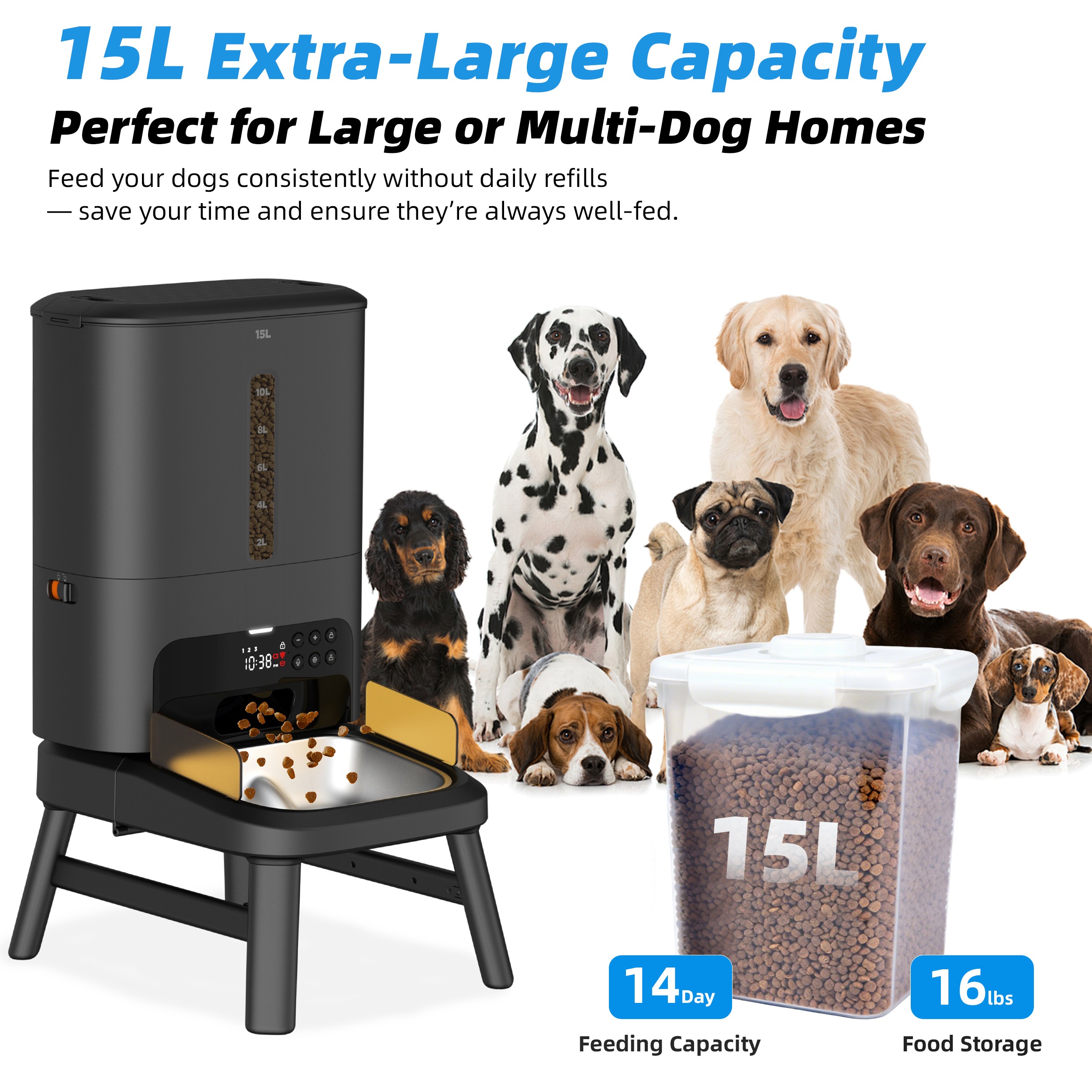
15L and above is rare, mainly for large dogs or high-intake households
Large-capacity feeders typically include these features:
Alerts when food is running low
Automatic reverses if kibble jams
Ideal for long absences or multiple-meal routines
This gives you a clear picture of common feeder capacities and practical advice for pets with special needs—objective and easy to understand.
4. Factors That Influence Capacity Choice
Choosing the right smart feeder capacity isn’t just about daily intake. Several other factors affect how much food your feeder should hold. Understanding these will help you make a smarter, more practical choice.
1) Kibble Size and Shape
Not all kibble is the same. Larger or irregular pieces take more space, while small, round kibble packs tightly. A 2L feeder can hold very different amounts depending on kibble type.
Check feeder specs for supported kibble types
Choose anti-jamming feeders for large/odd-shaped kibble
2) Refill Frequency Preferences
How often you want to refill the feeder plays a big role:
Busy owners may prefer larger capacity to reduce refills
Pet parents wanting fresh food may opt for smaller feeders
Balancing refill convenience with food freshness is key.
3) Food Freshness and Humidity Control
Even the best feeders can’t keep food fresh indefinitely if capacity is too large:
Large hoppers expose kibble to air, causing dryness or flavor loss
Moisture buildup leads to clumping or spoilage
4) Power Backup and Offline Feeding
Feeder size affects power and reliability requirements:
Larger feeders have complex mechanisms—continuous power is crucial
Dual power (adapter + battery) prevents feeding interruptions
Offline feeding/memory maintains schedules during outages/Wi-Fi issues
5) Household and Pet Considerations
Other factors to consider:
Number of pets – multiple pets increase daily food needs
Travel habits – long trips need feeders with more autonomy
Pet activity/age – active/growing pets need larger portions
Considering all these factors helps you choose a feeder that fits your lifestyle, keeps pets well-fed, and reduces mealtime stress.