
What Smart Pet Fountain Filters Really Remove: A Complete 2025 Deep-Dive
Date: 2025-12-05 Categories: Reviews Hits: 1025
What Smart Pet Fountain Filters Really Remove: A Complete 2025 Deep-Dive
I. Why Are Pet Owners Upgrading to Smart Pet Fountains in 2025?
II. The Most Common Contaminants Found in Pet Drinking Water (Updated for 2025)
III. What Exactly Is Inside a Smart Pet Fountain Filter? (Structure & How It Works)
IV. What Can These Filters Actually Remove? A Layer-by-Layer Breakdown
VI. 7 Most Common Questions Pet Owners Have About Filtration
VIII. Conclusion: Clean Water Is a Long-Term Investment in Pet Health
I. Why Are Pet Owners Upgrading to Smart Pet Fountains in 2025?
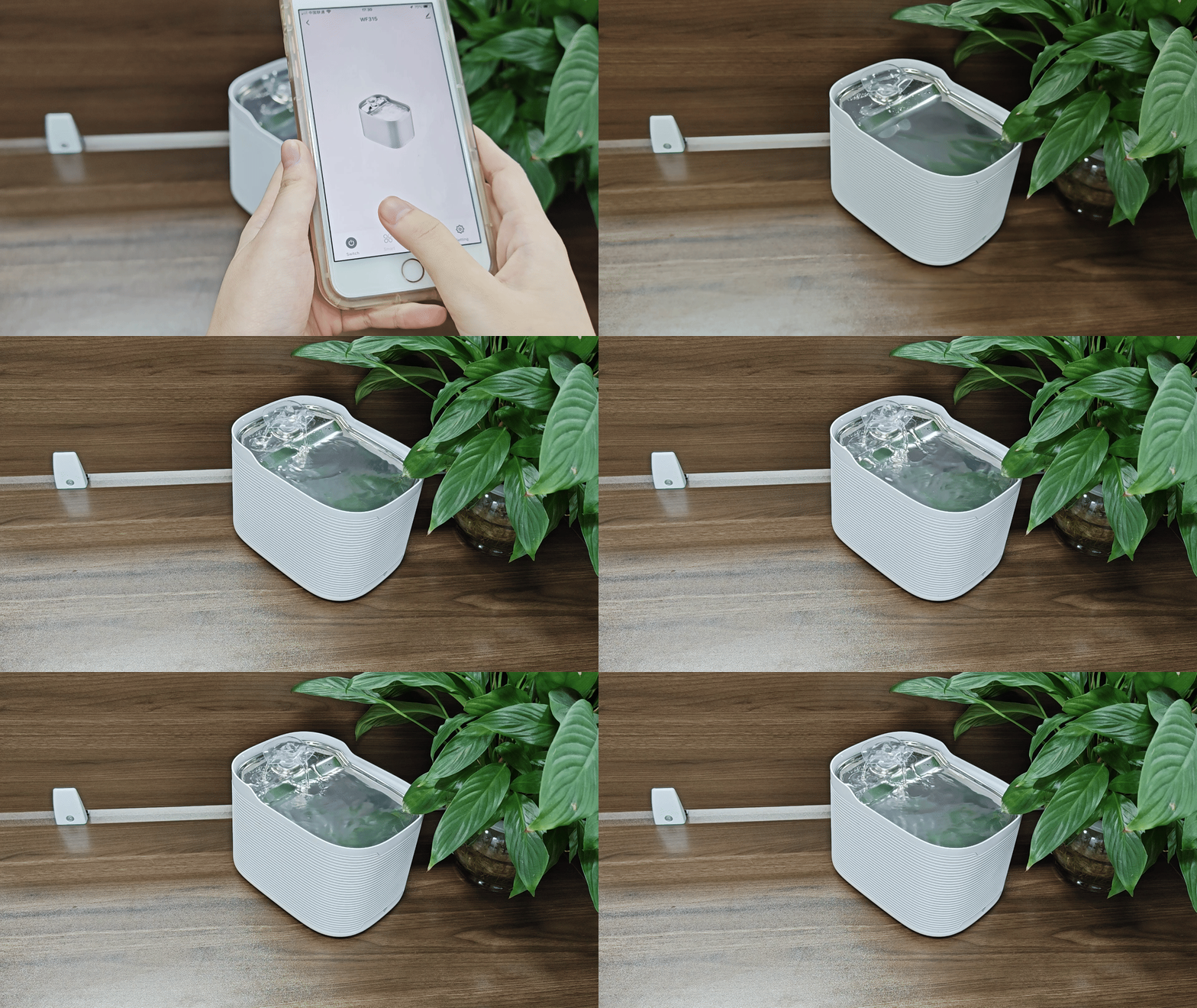
In 2025, smart pet fountains have become one of the fastest-growing categories in the pet care market — and it’s not just a trend. More pet parents, especially cat owners, are realizing that hydration plays a critical role in preventing urinary issues, kidney stress, and long-term overall health. Yet many pets simply don’t drink enough water from a traditional bowl.
At the same time, concerns about tap water quality are rising worldwide. Common issues — including chlorine, sediments, heavy metals, organic pollutants, and microbial growth — have pushed owners to seek cleaner, safer, and more reliable hydration solutions for their pets.
This is where smart pet fountains truly stand out. By circulating water continuously and using multi-layer filtration systems, they remove impurities, improve taste, and keep water fresher for longer. No surprise that one of the most frequently searched questions today is:
“What exactly can a pet fountain filter remove?”
In this article, we’ll break down the common contaminants in pet drinking water, analyze what modern filtration systems can actually filter out, and help you understand how to choose the right fountain for your home.
II. The Most Common Contaminants Found in Pet Drinking Water (Updated for 2025)
To understand what a smart pet fountain can truly filter, we first need to look at what might be lurking in your pet’s water. Even if your tap water is considered safe for humans, pets can be much more sensitive to taste, smell, and certain contaminants. Based on 2025 drinking water quality reports and veterinary hydration studies, here are the most common pollutants found in household pet water:
1. Hair and Dander
Pets shed constantly, and loose fur easily falls into standing water. Combined with dander and saliva, this becomes a breeding ground for bacteria if not removed promptly.
2. Food Residue and Dust Particles
Many pets drink water right after eating, which introduces crumbs, oil, and fine food particles into the water. Dust from the environment can settle on the surface as well.
3. Residual Chlorine in Tap Water
Chlorine is used to disinfect tap water, but pets often dislike its strong smell and taste. Long-term exposure can also irritate sensitive pets.
4. Heavy Metals (Such as Lead or Copper)
Aging plumbing, metal pipes, or low-quality infrastructure can introduce heavy metals into drinking water. These trace amounts can accumulate in a pet’s body over time.
5. Odor-Causing Compounds (Organic Matter & VOCs)
Organic pollutants and volatile compounds affect the taste and smell of water — one of the main reasons cats refuse to drink.
6. Bacteria, Mold Spores, and Microorganisms
Still water (especially in warm environments) can quickly develop biofilm, bacterial growth, or algae. Pets with weaker immune systems are more vulnerable to these risks.
7. Limescale and Mineral Deposits (Hard Water Regions)
Hard water areas — common in the U.S., Southeast Asia, and the Middle East — contain high levels of calcium and magnesium, which build up over time and negatively affect both taste and appliance lifespan.
III. What Exactly Is Inside a Smart Pet Fountain Filter? (Structure & How It Works)
Modern smart pet fountains don’t rely on a single filter material. Instead, they use a multi-layer filtration system, where each layer targets a different type of contaminant. Understanding these layers helps you evaluate how effective a fountain truly is — and why some models perform far better than others.
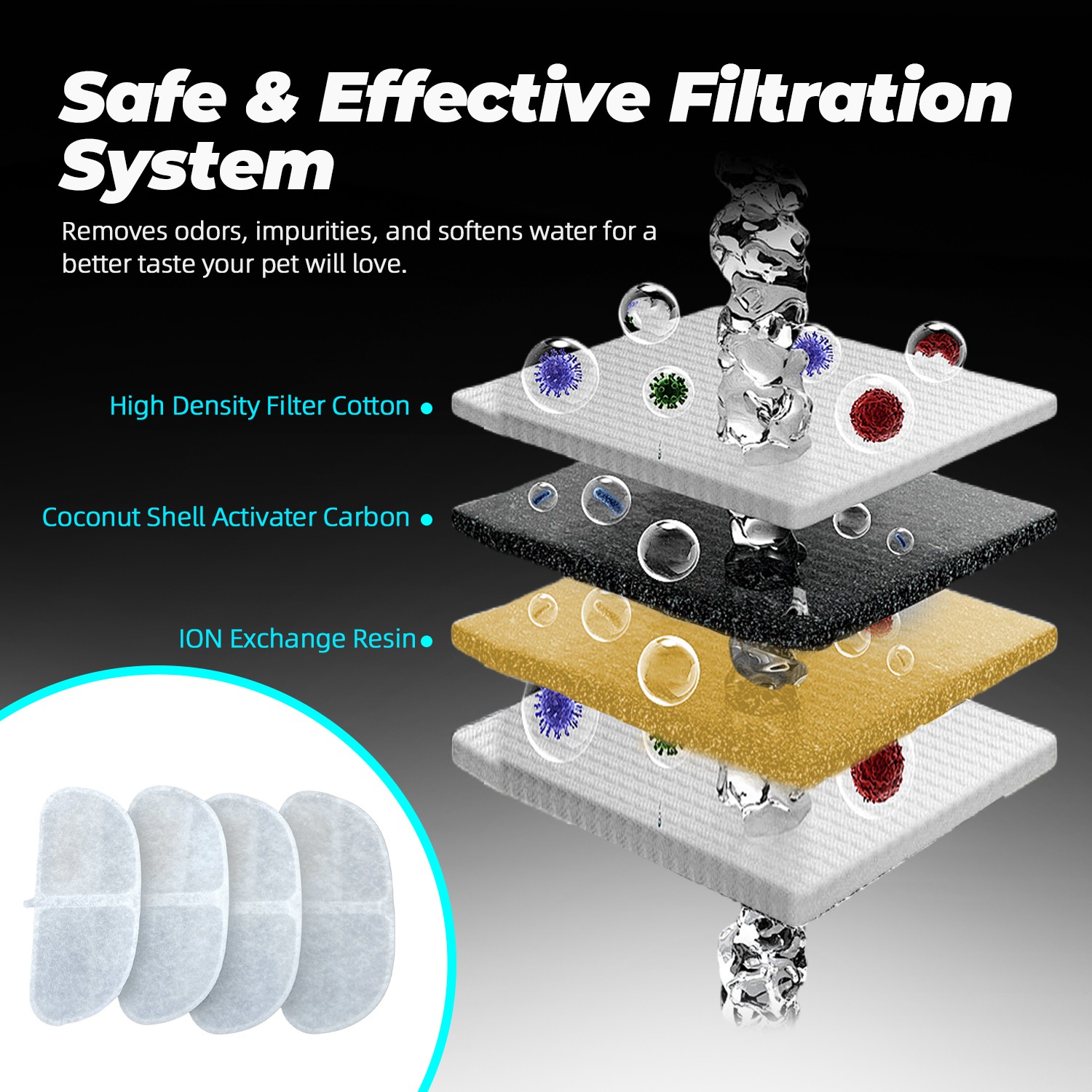
1. Pre-Filter Cotton (PP Cotton)
Purpose: Remove hair, dander, dust, and large particles.
This is the first line of defense. PP cotton captures floating debris before it reaches the pump, helping reduce clogging and extending the lifespan of the fountain.
2. Activated Carbon Layer (Usually High-Density Coconut Shell Carbon)
Purpose: Absorb chlorine, odors, organic compounds, and improve taste.
Activated carbon is extremely porous, giving it the ability to trap impurities that affect taste and smell. Coconut-shell carbon is often preferred for its higher absorption efficiency and better water purification performance.
3. Ion-Exchange Resin (Common in Higher-Grade Filters)
Purpose: Reduce water hardness by removing calcium and magnesium ions.
Ion-exchange resin is especially beneficial for households in hard-water regions. It softens the water, prevents mineral buildup, and helps reduce limescale formation inside the pump and water pathways.
4. High-Density Fine Mesh Filter (80–120 μm or higher)
Purpose: Capture micro-particles that PP cotton alone cannot retain.
This layer ensures that smaller impurities — dust, fine sediments, microscopic debris — are removed before the water is circulated back to the bowl.
5. UV Sterilization Module (Featured in Select Premium Models)
Purpose: Inhibit bacterial growth and maintain water freshness.
UV light doesn’t “filter out” particles but disrupts the DNA of bacteria and microorganisms, preventing them from multiplying. It’s a helpful addition for warm climates, multi-pet homes, or pets with low immunity.
6. Continuous Water Circulation & Aeration System
Purpose: Keep water oxygenated, moving, and resistant to microbial growth.
Flowing water is less likely to develop biofilm or odor. Aeration also enhances taste, encouraging pets — especially picky cats — to drink more.
IV. What Can These Filters Actually Remove? A Layer-by-Layer Breakdown
Now that we’ve covered the components inside a modern smart pet fountain, it’s time to answer the question pet owners care about most:
“What exactly gets filtered out — and how effective is each layer?”
To help you see the full picture, here’s a clear breakdown of the most common contaminants in pet drinking water and how each filtration component handles them:
Contaminant Removal Summary Table
| Contaminant | Filter Layer Responsible | Effectiveness |
|---|---|---|
| Pet hair & dander | PP cotton + fine mesh | ★★★★★ |
| Food crumbs & debris | PP cotton + fine mesh | ★★★★★ |
| Chlorine taste & smell | Activated carbon | ★★★★☆ |
| Odor-causing organic matter | Activated carbon | ★★★★☆ |
| Heavy metals (lead, copper) | Ion-exchange resin | ★★★★☆ |
| Limescale / mineral deposits | Ion-exchange resin | ★★★☆☆ |
| Micro-particles / fine dust | High-density fine mesh | ★★★★★ |
| Bacteria & microorganisms | UV module + continuous circulation (inhibits growth) | ★★★☆☆ |
| Biofilm formation | Circulation + aeration | ★★★☆☆ |
How to Interpret This Chart
1. Excellent Removal (★★★★★)
Layers like PP cotton and fine mesh capture physical impurities with extremely high efficiency. These are the most visible pollutants (hair, crumbs, dust) and are fully addressed by most smart fountains.
2. Strong Removal (★★★★☆)
Activated carbon and ion-exchange resin excel at handling chemical contaminants, including chlorine, odors, and heavy metals. These improve taste, smell, and safety, which are crucial for encouraging pets to drink more.
3. Moderate Support (★★★☆☆)
UV sterilization and circulation don’t “remove” particles but prevent bacterial growth, keeping the water fresh for longer. They work best as assistance features rather than primary filtration.
Key Insight for Pet Owners
A good smart pet fountain doesn’t rely on just one filter component — it uses multiple layers working together. This combination ensures your pet gets:
Cleaner water
Better-tasting and better-smelling water
Lower risk of microbial growth
Reduced mineral buildup in the fountain itself
Longer-lasting pump and filtration system
V. What Makes Tikpaws Filtration Better?
While many pet fountains on the market use basic two-layer filters, Tikpaws adopts a higher-grade, multi-layer filtration system designed for global water conditions and long-term pet safety. By combining advanced materials with thoughtful engineering, Tikpaws fountains deliver cleaner, fresher, and better-tasting water — especially for picky drinkers.

1. True Three-Layer Integrated Filter (PP Cotton + High-Density Carbon + Ion-Exchange Resin)
Most low-cost fountains only include PP cotton and carbon. Tikpaws goes further by integrating premium ion-exchange resin, offering enhanced performance:
PP cotton: traps hair, food residue, dust, and sediments
Activated carbon: absorbs odors, chlorine, and organic impurities
Ion-exchange resin: reduces water hardness, limescale, and heavy metals
This combination ensures broader filtration coverage and noticeably improves water clarity and taste.
2. 360° Full-Circulation Water Pathway (Eliminates Dead Zones)
Tikpaws engineers redesigned the fountain structure so water moves evenly from all directions, reducing stagnant pockets where bacteria often grow. This consistent circulation keeps water:
Fresher
Better oxygenated
More appealing for cats and dogs that prefer moving water
3. High-Efficiency, Low-Noise Pump (Durable + Anti-Clog Design)
A superior filtration system must be paired with a reliable pump. Tikpaws uses:
High-flow circulation for cleaner water
Noise levels ≤ 30 dB, ideal for night use
Anti-clog channels, supported by pre-filter layers
The result is longer pump lifespan and reduced maintenance.
4. Optimized for Global Water Quality (Including Hard-Water Regions)
Many countries — such as the U.S., Mexico, Southeast Asia, and the Middle East — experience high water hardness. Tikpaws filters are specifically designed to:
Lower calcium and magnesium concentration
Prevent scale buildup inside the pump
Improve taste for pets sensitive to mineral-heavy water
This makes Tikpaws fountains especially valuable for international customers.
5. Smart Filter Replacement Reminder (No More Guesswork)
Old filters lose effectiveness and may even cause odors. Tikpaws models include a filter replacement alert, ensuring you always change the cartridge at the right time.
This feature helps pet owners maintain consistent water quality and extends the overall lifespan of the fountain.
VI. 7 Most Common Questions Pet Owners Have About Filtration
Understanding the technical details of smart fountain filters is one thing — but real-world users usually ask practical questions. Here are the seven most common questions Tikpaws receives, along with clear, expert answers.
Water may develop odors
Minerals and impurities may accumulate
Bacteria could grow faster
VII. How to Choose the Right Smart Pet Fountain in 2025
With so many smart pet fountains available, it can be overwhelming to know which one truly meets your pet’s needs. Here’s a practical, 2025-ready guide to selecting a fountain that keeps your cat or dog hydrated, healthy, and happy.
Look for Multi-Layer Filtration (At Least 3 Layers)
A good fountain should include PP cotton, activated carbon, and ion-exchange resin. This combination ensures that hair, debris, chlorine, odors, and heavy metals are effectively filtered.Check the Filter Materials
High-density coconut-shell activated carbon is more effective than generic carbon.
Food-grade PP cotton and resin are safe and durable.
Avoid fountains with low-quality or unspecified filter materials.Consider Pump Noise and Durability
Low-noise pumps (≤30 dB) are essential for night use.
A durable pump with anti-clog design ensures long-term, maintenance-free operation.Circulation & Aeration Features
Continuous water flow and aeration prevent stagnant water, inhibit bacterial growth, and encourage pets to drink more. Multi-directional circulation is ideal.Water Hardness Considerations
If your tap water is hard, a fountain with ion-exchange resin is necessary to prevent scale buildup.
In soft-water regions, basic multi-layer filtration may suffice.Water Capacity & Multi-Pet Households
Single-pet households: 1–2 liters is usually sufficient.
Multi-pet households: choose a larger water tank (>2 liters) to avoid frequent refills.Filter Replacement Reminder
A built-in filter replacement alert helps maintain water quality.
Forgetting to replace filters is one of the most common causes of water quality decline and fountain issues.Ease of Cleaning
Detachable components and smooth surfaces reduce bacteria growth.
Dishwasher-safe parts (if available) save time and ensure hygiene.
Pro Tip:
Investing in a high-quality smart fountain now can save you money on veterinary bills and prevent health issues related to dehydration or contaminated water. In 2025, smart fountains are not just a convenience — they are a long-term investment in your pet’s well-being.
VIII. Conclusion: Clean Water Is a Long-Term Investment in Pet Health
Smart pet fountains in 2025 are no longer just a luxury — they are an essential tool for keeping cats and dogs hydrated, healthy, and happy. A well-designed multi-layer filtration system, combined with circulation and aeration, ensures water stays clean, fresh, and appealing. By understanding what each filter layer does and choosing a fountain suited to your water conditions and pet’s needs, you can prevent common hydration issues and reduce the risk of urinary and kidney problems.
Investing in a high-quality smart fountain, like the Tikpaws WF315, is a long-term commitment to your pet’s health. Regular filter maintenance, cleaning, and paying attention to water quality will ensure your pet enjoys clean, safe drinking water every day.